


US Workforce Trends 💼
The situation is… relatively the same
As data has slowly been trickling in over the month, adding to some data gaps from November and December of 2025, things are looking consistent with what we’ve been experiencing for the past several months.
The Federal Reserve decided to keep the interest rate at 3.75-4.00% due to inflation. They said in order to lower it, they would need to see the labor market getting more stagnant or inflation going down. One of these things seems much more likely than the other… and its not inflation going down.
November jobless rates were up year over year in 259 of the 387 metro areas measured. So, roughly 67% of metro areas are experiencing a harder labor market than they were in November 2024, which was also a tough time.
Bureau of Labor Statistics reported 50,000 jobs added in December. This closely aligned with the ADP Report’s job numbers as well.
Something I found interesting was in November, US import prices (how much we pay for goods coming into the US) only rose .1% over 12 months. Export prices rose 3.3%. Everyone was expecting import prices to go up due to the tariffs, but that is not being seeing in the data.
Overall… not much to report on here.
Consumer confidence still going down, fear going up
Consumer confidence shot down in January to levels lower than any we experienced during the pandemic. Particularly, Americans short-term expectations for income, business conditions, and the job market tumbled to 65.1. This is the 12th consecutive month the reading has been under 80, which is the typical indicator for a recession ahead.
I wonder how much media has a role in this. We all know that “bad news sells,” and that the regular consumer is a pawn for different news agencies or sides of the aisle when they’re trying to sell a narrative. We’re now in this constant state of fear that something bad will happen (or is). While the short-term expectations could be an early recession indicator, I think it could also be a signal of the current state we’re all perpetually stuck in. I try to keep this in mind when I write on these subjects, as I don’t want to add to any fear but want to keep people informed.
Some of the fear is justifiable though. When the Feds are making constant changes to the data they report on, it’s hard to to trust their narrative. They try to tell us the job market isn’t that bad, meanwhile 2025 was the weakest year for job gains (outside of the 2008 recession) since 2003. Even the people who were optimistic are slipping. According to the same survey, 27.5% of surveyors in December thought jobs were “plentiful,” but that number dropped to 23.9% for January. That’s a steep decline.
BLS posts industry and occupational employment projections
The BLS posted their industry and occupational employment projections for 2024-2034. They are projecting total employment to grow 3.1% between 2024-2034, adding about 5.2M new jobs. Industries they’re predicting to grow the most are healthcare and social assistance (8.4%)(with nurse practitioners growing the fastest), professional, scientific, and technical services (7.5%), information (6.5%), and art, entertainment, and recreation (5.1%)(interesting!).
They also projected the number of self-employed workers to increase by 2.2%. I thought this was interesting, but I also agree with it. We’ve been seeing many companies cutting overhead/staffing and moving toward contracting out for services. As we move away from being able to rely on employers for security, I’m not surprised to see a push toward self-employment (for better or for worse).

Global Scope 🌍
The Chinese government is starting to show concerns over their labor market. During the lunar new year (mid-February), many folks who travel to larger cities for work return back to their home towns in more rural regions. This year, the Chinese government is worried these travelers won’t return back to the cities for work.
China has been experiencing a turbulent property market, reducing many construction jobs in larger and medium-sized cities. Building sites and factories aren’t producing as many jobs as they used to. Local economies are not well setup to absorb an influx of these jobseekers though, which would make jobs more competitive and push down wages. China’s rural affairs ministry declared that the government must prevent migrants from sticking around in their home villages after the holiday season.
Work Wins, Woes, & Whoas
Work Wins 🏆
Aldi, the grocery store chain, is leading the way for employee salary and satisfaction while still keeping prices low for customers. In a research study performed by Revelio Labs, they looked into Aldi’s success.
Aldi runs a tight ship, with only having about 5 employees per store in the US. Most other comparable grocery chains have around 30 employees per store. Their model depends on productivity. They incentivize their workers to be efficient, with performance metrics tracking check-out and delivery unloading speeds. While this may sound stressful, they also compensate them for their efforts, outranking competitors and just trailing Costco for average salary ~ $48,7k. They also report high satisfaction among their workforce, and locate many stores in suburban areas close to where their workers are for shorter commute times. Maybe other grocers could take some notes from their success. While they don’t produce the most jobs, they do create jobs of higher value.
Work Woes 📉
2025 college graduates are having a tough time finding jobs that align with their field of study. In 2022, about 26% of graduates reported finding a job in their field of study, but that number dropped to 20% in 2025. This is in alignment with trends for finding jobs as well. In 2022, about 42% of graduates reporting finding a job in the same year, but that number dropped to about 36% for 2025. We’ve talked before about the over-saturation of degree holders in the job market compared to the number of open jobs requiring a degree, but now we’re also seeing the misalignment with the types of degrees people are getting and what jobs are available.
Work Whoas 🚨
Business Insider reports that “the white-collar workplace has gotten a lot less cuddly in the past few years.” With the labor market slowing, attracting and retaining employees is not a key challenge for businesses (wow, shocker). This is what we call an “employers’ economy.“ Minimal job prospects = higher competition for remaining jobs. When competition is high, employers can (and do) lower the bar for what they offer to employees in return. We’re all experiencing uncertainty, and employers are capitalizing on this by reducing their overhead, offering less, and giving their shareholders more.
🔦Career Spotlight🔦
Welder
This role is expected to see steady demand through the next decade as infrastructure projects, manufacturing, construction, and energy sectors continue to grow. While some white-collar industries have experienced layoffs, skilled trades like welding have remained in high demand in 2025 due to labor shortages and ongoing investments in infrastructure and industrial projects. Hubs for welding jobs include TX, CA, OH, PA, and states along the Gulf Coast, where manufacturing plants, shipyards, and energy facilities are concentrated. Pay for welders typically ranges between $16/hr as an apprentice to upwards of $35/hr for more experienced workers.
Becoming a Welder: Most welding roles require a high school diploma or GED, along with completion of a technical school, trade program, or apprenticeship. Employers often look for industry certifications (such as an AWS certification) and hands-on experience with welding techniques like MIG, TIG, and stick welding. The role requires strong attention to detail, physical stamina, and a focus on safety. Starting in entry-level or apprentice positions allows welders to build skills and experience, leading to higher-paying roles in specialized fields such as pipeline, underwater, or industrial welding over time.
Who’s Hiring 🔍
Hiring in 2026 has been off to a slower start than usual, with many big corporations like Amazon and UPS even performing massive layoffs.
Government (mainly local and city level) - You can find government jobs at… governmentjobs.com or check with your local school districts.
Hospitals and Healthcare systems (as usual) - You can find healthcare jobs HERE.
Technology and cybersecurity - While many firms are also performing layoffs, there is still a trend in tech jobs being more available. Check out some tech jobs HERE or HERE.
I wish I had more employers that are hiring to report on… :(
2026 BINGO Update
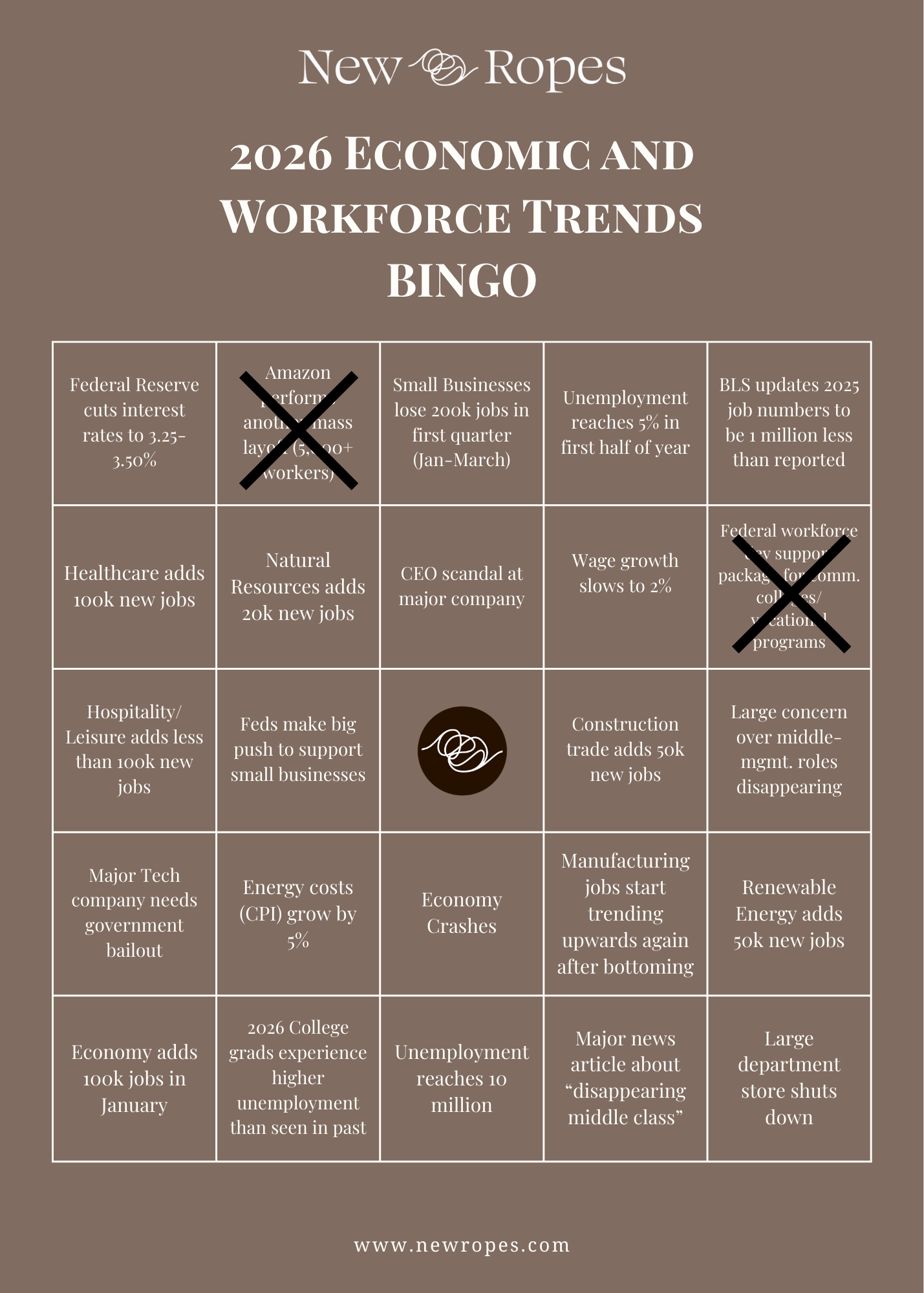
We get to cross off two boxes on our 2026 BINGO card:
Amazon performs another mass layoff (5,000+ workers) - Amazon just announced the slash of 16,000 jobs, bringing their recent layoffs to about 9% of their corporate workforce. That one didn’t take long…
Federal workforce development support package for community colleges/ vocational programs - The Department of Labor announced on January 6 the availability of $145M in funding to support performance-based registered apprenticeship (apprenticeships are a type of vocational program, so I’m counting this one) expansion across the US.
In case you missed it ⬇️
I tried freelancing. It didn’t work out. Now I’m going back to an office job.

I don’t think everyone is cut out to be their own boss.

This is such a tough spot for new grads. They did what they were told would work, and everything shifted midstream. Such an urgent problem that needs to be solved.