


US Workforce Trends 💼
Jobs and labor data continue to prove inconsistent.
I was hopeful that this November Roundup would have more data to work with than the October Roundup, but that is not the case. Because of the government shutdown, data was not collected, with some data not measurable retroactively. Now, we’re left piecing together data from private sources and skimming through anything the Bureau of Labor Statistics (BLS) has released.
The BLS announced they won’t be releasing September employment and unemployment data until December 11 - conveniently the day after the Federal Reserve is meeting to determine next interest rate cuts (rate cuts don’t seem likely). I say “conveniently,” because if data showed negative trends for employment, the Feds would be pressured to lower the rates again, even with inflation persisting and the stock market booming.
The BLS also announced they won’t be releasing the Consumer Price Index data for October, but they will be releasing November data on December 18, also conveniently after the Feds meet. The BLS will be releasing August data on job openings and labor turnover (JOLTS) tomorrow, NO data release for September, and October/November data on the 9th.
JOLTS data is arguably more important than unemployment data, as unemployment shows a current trend, but job openings demonstrates which direction we’re headed in next. If jobs aren’t being created, even with the rate cuts we’ve had, then this will demonstrate that the interest rate cuts have little to no impact on whether businesses will reinvest and create more jobs. AKA - new methods would need to be implemented in order to incentivize the private sector to create more jobs.
Here’s what we do know:
The August jobless rates were higher than the year prior in 243 of the 387 metropolitan areas measured, with some metros reaching 20%.
Unemployment rose in September to 4.4% (7.6 million people), from 4.3% in August, so unemployment is going up, but gradually.
ADP jobs report says private employers added 42,000 jobs in October (first jobs added to outpace cuts since July). Jobs were shed in business services, information, and leisure and hospitality. Education, healthcare, and trade and transportation led the growth, per usual.
However, Revelio Labs reported that the economy lost 9,100 jobs in October.
We won’t have a clearer picture of how many jobs were added or lost in October until the BLS releases their numbers, but these different reports accurately reflect the confusion and lack of consistent data.
Job cuts have surpassed 1 million for the highest October total since 2003.
Employers announced 153,074 cuts in October.
This year through October, US employers announced 488,077 planned hires, down 35% from this point in 2024.
Something to keep an eye on is the US import and export price indexes to be released on December 3. A large contributor to the chaos being experienced in the job market is tariffs. The import and export data we’ll see will be very telling of the impact the tariffs are having on trade and prices.
Overall, it is difficult to tell how the economy is actually doing. On the front of my mind still is the BLS correction to 2024 data, where they revised the job openings number to 911k less than they originally reported for 2024. With unemployment higher in 2025, I’m hesitant to believe recent job openings numbers, and I’m doubtful many jobs have actually been added this fall. We won’t truly know what we’re experiencing until next year when they release revised numbers for 2025.
Tyson is “right-sizing” their business by performing layoffs and lining investor pockets.
America’s largest meat supplier, Tyson Foods, announced it is closing one of its largest beef-processing plants in Lexington, Nebraska, laying off about 3,200 employees in a town the size of only 11,000. Another plant in Amarillo, Texas is also laying off over 1,000 employees. The company cites droughts, low cattle supply, and high costs of inputs for the layoffs, stating costs rose nearly $2 billion for the past fiscal year. Meanwhile, it’s operating income increased by 26% this year compared to 2024, so it looks like they’re still doing well?
Tyson is saying it needed to “right size” its business, even though beef has been at (artificially?) record-high prices this year. At the same time, the company paid its CEO $22.7M - 525x its median employee’s salary. It also spent $196M in stock buybacks. Companies may buy back their own stock if they think it is undervalued on the market (signaling confidence in itself) and/or if they want to raise the remaining share prices, but it is more often used to reward shareholders and investors. So what does this mean?
Appeasing shareholders will always take precedence over anything else. The Tyson CEO and its investors are having a great year financially while its employees lose their jobs before Christmas. Many companies have in the past tried to avoid layoffs before the holidays for morale, but this is not the case for Tyson’s insatiable greed.
US Consumer Confidence is sharply declining.
According to the Consumer Confidence Survey by the Conference Board, consumer confidence fell sharply in November across jobs, incomes, financial institutions.
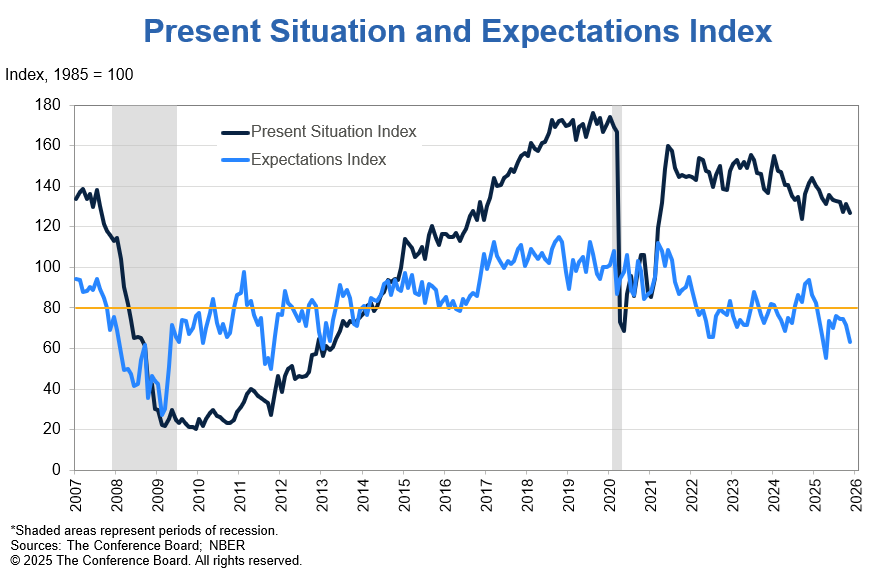
The Expectations Index, which is based on short-term outlook for income, business, and labor market conditions, fell by 8.6 points to 63.2. The index has tracked below 80 for ten consecutive months, the threshold used to gauge signals for an upcoming recession.
Something interesting about this is that US consumer spending has not been going down. Those earning over $100k spent 4.3% more in the third quarter than a year ago, and those earning less than $60k still spent 3.8% more. Sounds to me like lay-away retail therapy.

Global Scope 🌍
Indian Prime Minister Modi is changing up India’s labor laws.
In India, 95% of industrial firms employ fewer than ten workers, other firms have exactly 99 employees, and 42% of the manufacturing workforce is contracted labor. These strange stats can be owed to their complicated labor laws. On November 21st, Indian’s Prime Minister Narendra Modi announced he plans to liberalize hiring and firing and increase flexibility for and simplify compliance to free up India’s labor market.
Currently, many rules only apply to firms with ten or more staff, and they typically cause a 35% increase in labor costs. This had led to a “missing middle” where companies either remain small, or they’re large enough to cope. India’s Industrial Disputes Act also makes it incredibly difficult for firms with over 100 employees to fire any workers. These laws have discouraged companies from scaling, investing, and hiring.
PM Modi’s proposals includes promises of social security for gig workers, added rights to contract, and the removal of restrictions stopping women from working at night or in specific industries. They’re hoping this will free up labor, add more jobs to the economy, and make the country more competitive globally.
Work Wins, Woes, & Whoas
Work Wins 🏆
Parents often have to make the difficult decision of whether to both return to work to pay for childcare or for one parent to take care of the children full time while the other parent brings in an income. Well, beginning November 1st, 2025, New Mexico became the first state to offer universal, no-cost child care to all families, regardless of income. This amounts to an average annual family savings of $12,000 per child.
They are also taking actions to build up childcare statewide through establishing low-interest loans to construct and expand child care facilities, partnering with employers and school districts to expand care options for working families, and launching a statewide campaign to recruit licenses and registered home providers. These efforts are being paid for through their Early Childhood Education and Care Fund. In 2019, New Mexico started planning for the program by adding $320 million from surplus oil and gas revenues to the fund, growing it to over $10 billion now. As child care costs continue to rise and demand for free child care grows, time will tell which other state’s follow in New Mexico’s footsteps.
Work Woes 📉
The Education Department has proposed to reclassify certain professions and remove them from being considered “professional” degrees, beginning July 1, 2026. Most notably, the administration removed nursing, education, physical therapy, physicians assistant programs, social work, and others from the list, sparking alarm amongst… everyone.
Of course, what this truly has to do with is money. Under the proposal, students pursuing “professional” degrees could borrow up to $50k annually, $200k lifetime limit. Graduate programs excluded from the professional category would receive lower caps of $20,500 per year and $100,000 lifetime limit.
It is so odd that this is where the administration is choosing to cut costs. Some say the hope is for universities to lower tuition, but targeting our most vital pipeline of healthcare and education workers seems to be a big risk for a problem that could be addressed through other means. The health care industry continues to grow, and demand for health care professionals is one of the only factors propping up any positive job growth numbers we’re seeing. A reduced health care workforce, due to inaccessible education, could lead to immeasurable damage and lives lost. Projections already note that 40% of nurses are expected to leave the workforce by 2029.
Work Whoas 🚨
Scandal and controversy have broken out at the HR professional firm Society for Human Resource Management (SHRM). SHRM is a national leader in providing educational materials and credentialing programs to HR professionals. It has helped shape HR departments across the country, along with national policy, briefing judges and lawmakers on workforce practices. Recently, some problems have come to light regarding the company, and former employees opened up to Business Insider about what’s been going on. It doesn’t look good.
Typically, when a business has to perform annual job cuts or organization restructuring, it is seen as a sign of poor management and planning - according to SHRM, anyway. SHRM does not do as they say though, and perform layoffs annually. Employees report that people who are not 100% aligned with the latest messaging from leadership were typically laid off or encouraged to find another job. Others stated than managers said they liked instilling fear into their employees to keep them performing, even though SHRM essays report doing so negatively affects the workplace. Let’s not even touch on their 1-minute-late policy, the dress code, or the sultry birthday performances.
For a company that sells HR guides and best practices, they sure like to go against their own advice.
🔦Career Spotlight🔦
Logistics and Supply Chain Analyst
Demand for Logistics and Supply Chain Analysts is expected to remain strong throughout the next decade as global trade, e-commerce, and manufacturing continue to expand. Organizations across industries depend on efficient supply chains, and demand for professionals who can analyze data, optimize operations, and maintain smooth product flow is steadily growing. Logistics and Supply Chain Analysts play a key role in improving inventory management, reducing costs, and maintaining timely delivery of goods. The work is analytical, fast-paced, and cross-functional. As of 2024, annual salaries typically range from $58k–$90k, with analysts in manufacturing, transportation, and large corporations earning on the higher end.
Becoming a Logistics and Supply Chain Analyst: To get started, most employers require a bachelor’s degree in supply chain management, logistics, business, operations management, or a related discipline. Many programs blend include data analysis, procurement, inventory systems, and operations planning with practical case studies or internships. While not always mandatory, certifications such as APICS CPIM/CSCP, Certified Supply Chain Professional, or Six Sigma can strengthen your qualifications and career prospects. If you’re interested in the field without obtaining a degree, experience can be gained through entry-level warehousing and inventory management positions.
Who’s Hiring 🔍
Ford: The Ford CEO announced they have 5,000 open mechanic jobs with 6-figure salaries but are having trouble filling them because of manually skilled worker shortages.
Wells Fargo: Increasing their hiring in November and December.
RobinHood: Announced they are expanding their teams and growing the company.
ASML: The world’s leading machine manufacturer for chip-making (think AI) is growing and increasing their hiring globally.
Oscar Health: This startup health insurer is growing their team.
In case you missed it ⬇️
Getting blamed is a blessing.

Things begin to change the moment you take accountability for your life.